From the category archives:

Uncategorized

This is why Eagle Valley Search Dogs is proud to be a member of the New York Federation of Search and Rescue Teams.

Clara Layman

Clara Layman

Clara “Dolly” Layman, 73 of Laurens, NY went missing Saturday evening, August 21st.  She suffers from early stages of Alzheimer’s.  Police and Fire personnel from Laurens and nearby Oneonta begin the search by canvasing neighbors. They checked trails and roads and woods right near the home. They called for more support.  They called the New York State Forest Rangers. Mrs. Layman lives in a heavily wooded area. If  someone you love is lost in  any part of New York where the trees outnumber the buildings, get the rangers.  They are the experts.  In 2009 they conducted 144 searches and almost as many rescues.  Surprised?  Most of these stories never make the news.  I don’t know why.

About 10 PM the ranger in charge at the time, Ian Kerr, called Roger Fox,  Federation Chairman.  When the Rangers need manpower, they call us.  Most of the searches I go on are run by rangers.  And in keeping with the tradition of quasi-anonymity, the Federation doesn’t get mentioned in the news much either.

The search area was just outside Oneonta. The closest Federation member teams are us and Amigo. But we are both K-9 only teams and Ranger Kerr  requested ground teams.  The call went out to the next closest teams in the Adirondacks and Hudson river valley.   And people gave up their Sunday plans, got out their rain gear and showed up. About 20 Federation members join 80 or so other local searchers including rangers, state troopers, several local fire departments, and neighbors.  All mobilized in about 10 hours time.  We were all told to report at 7AM Sunday. Many of us got there early.

Here was a search for an older person that was being conducted with the same fervor and intensity you would search for a missing child.  That is saying something.   People are hardwired to respond when a child is in danger. That is why charities so often focus on the plight of children to garner support.  The urge to rescue a child is automatic.  And when there is a child missing rangers have to worry about how to manage volunteers.  The numbers can be overwhelming.  The right response for a missing adult doesn’t come quite as naturally to most of us. It has to be thought about. It has to be trained.  We need to be reminded of the danger.  Clara Layman might have fallen into the pond near her home and drowned.   She could be injured.  Amir and I spent a good part of Sunday searching a couple of neck breaking ravines near her house along with Ranger Joe Bink and a few members of the local community. What if she had stumbled and fell? Clara Layman  is the same age as my mother! I imagined her in the woods–cold, wet, and lost. I imagined myself in the same situation a few years from now.

Sunday ended and Clara Layman was still missing. A second night in the woods, this time a wet one.  Even in August it can be cold at night.  I drove home  worried. It can be difficult to get a good turn out for a weekday search. How many volunteers could afford a day off of work in this economy?

But Monday’s turnout was way better than I expected.  More rangers arrived from other parts of the state. So many State Police were in the woods that somebody remarked it might be a good day to rob a bank. Roger put the call out to the entire Federation.  And they came……from Lima, Brockport, Waterford, Boonville, Gloversville, Piffard, Johnstown, and Fishkill. Fonda, Saugerties, Munford and West Babylon. Palatine Bridge, Middle Grove, Hancock, Brooklyn, Canajoharie…and…New Jersey.

More than 40 federation volunteers from eleven different teams showed up.

small federation logo

The outcome?  Clara Layman, the woman who could be  me a few years from now, or my parent, or yours….was found alive and well around noon today, Monday August 23, 2010.  She was about 1/2 mile from her house in the woods. She was found by a crew of volunteers–ground pounders, not a dog team. The volunteers on the team that found Clara were not from the federation. They were all from local fire departments.  But none of that matters.  We were all there. All of us.

{ 1 comment }

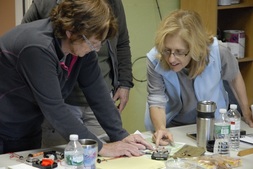
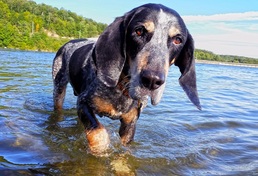
These are two collages my computer made. I’m not sure every picture is visible as the order is random. Click on each collage to make it bigger. I need to figure out a way to have team members be able to access all of the 51 or so pictures.

{ 0 comments }

You have the boat, the divers or the scent generator, access to the lake.  If this is the first time you have been in charge of organizing a  What else should you be thinking about?

  1. Check your gear way ahead of time. This is especially important at the start of the season. Do it far enough in advance so that you have time to get things repaired or replaced.
    A few years ago, I got out our inflatable boat the night before training.  It had been nicely packed away for the winter.   Mice had eaten holes right in the side.  There we were scrambling for a replacement at the last minute.
  2. Remind your team members about the equipment they will need just for water work. If you have done a lot of water training this list will seem obvious. But if you usually do wilderness work–its very likely that you won’t remember one or more of the following:
    • Shade–it will be in short supply. Bring your own. 10 by 10 pop-ups work great
    • PFDs
    • Clothes suitable for boating and towels to dry off with for handler and dog.  Sound obvious?  Try it. Don’t remind them and see how many of your teammates show up in their usual BDUs and Hiking Boots
  3. Boat Tenders:  On searches you will often have local people driving your boat. But on trainings that job often falls to team members.  Develop a cadre of experienced boat handlers and get them in your boat and out practicing before your water training day.
  4. Set up will take longer than you expect, way longer. If you have divers factor in the time it takes for them to get geared up. Also, they will need to swap out frequently. If you are using some other source like  a scent pump, it still takes a God-awful amount of time to set up a problem. The hose will always float; the dobber, float or anchor will always come loose, the pump will fail, batteries die. Count on it.By the way, did you invite the local dive team to practice with you? Great. Want to keep them happy?  Feed them. And if the weather is at all chilly to arrange for hot food.
  5. Assign team members to crowd control and public relations.  If you are training in a high use area and you have two boats, put one of your people in the second boat to answer questions and manage traffic from the water as well. Use one of your most experienced people. Make sure they have the answers to frequently asked questions.  Who are you?  Did somebody drown? Who gave you permission to train here? Can the dogs really smell things under water? Have you ever found a body? What do you train with?  Are you putting body parts in the water? You get the idea.
  6. Run your most experienced dogs first.  Get the kinks out of your set-up using dogs that know what they are doing
  7. Have observers on shore watching the dog’s behavior with some way to communicate to the handler. This is good advice for searches as well. It’s damned hard to see subtle changes in K-9 behavior from behind the dog.
  8. If you have a large team, set up multiple problems so that handlers can use down-time profitably.
  9. Pre-plan rotating your key positions. Your observers can’t watch all the dogs, they need to work their own. Likewise, your drivers and Public Relations staff.
  10. Try to plan 5 water training days a year.  Your dogs need the repetitions. You need the practice.  You put all this work into planning a super training day for your team.  Get the most out of it and do it again.

{ 0 comments }

Here is a link to a recently published article in the CNY Magazine:

http://k9chp.blogspot.com/2010/05/blog-post_17.html

{ 0 comments }


Aren’t we all GPS users? Well beware, and see why below!

GPS geek alert!

{ 0 comments }